An Evil Little War
The 1999 Battle of Kosovo as birth of the Globalist American Empire - and a seed of the multipolar world

In the early hours of March 24, 1999, NATO began the bombing of the Federal Republic of Yugoslavia. The bloc called it “Operation Allied Force”, while the US military dubbed it “Noble Anvil.” Yet however much NATO spokesmen and their cheerleading press would spin, lie, and fabricate otherwise, there was nothing noble about NATO’s aims.
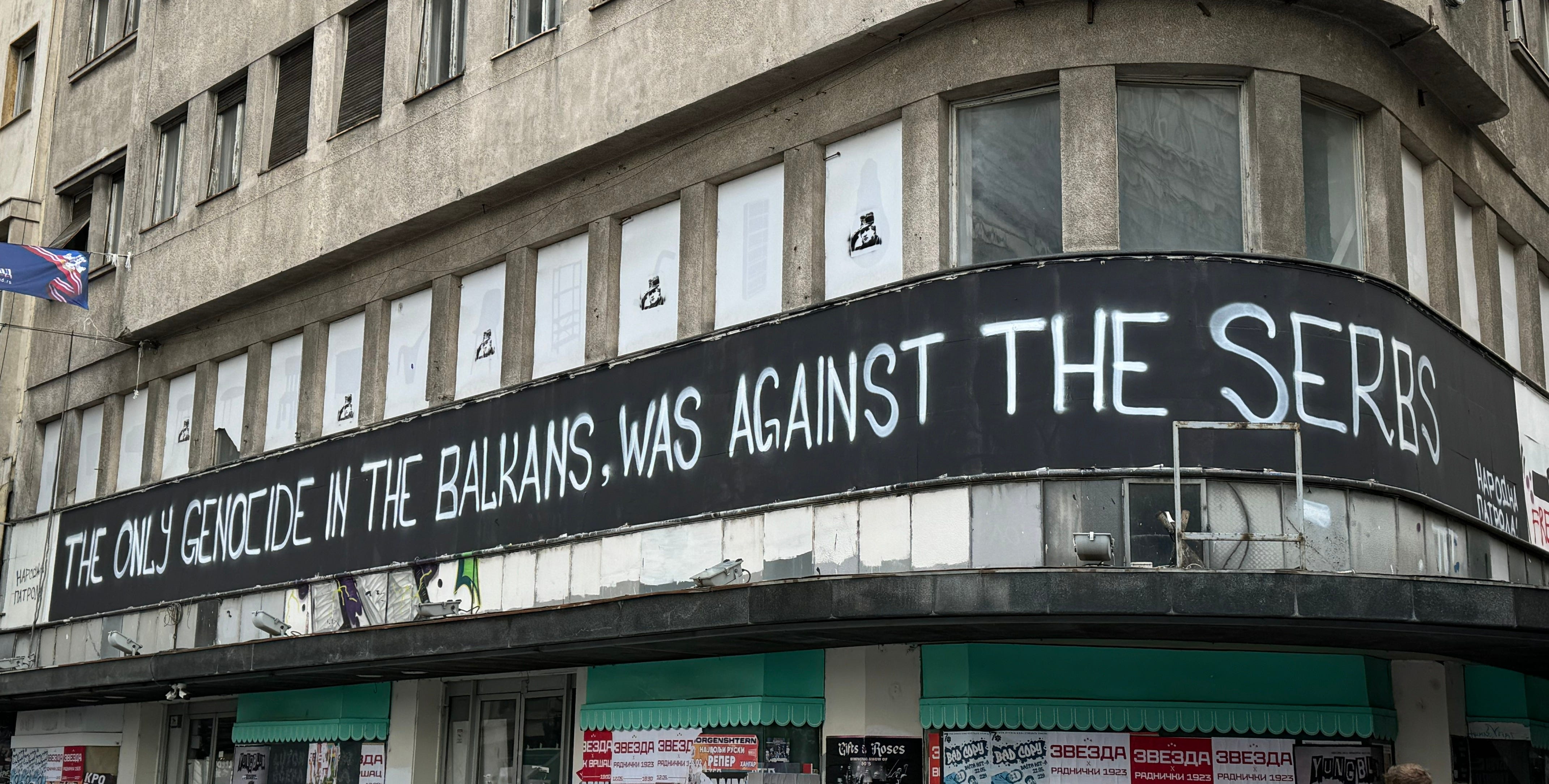
There’s no denying the war was illegal. NATO’s actions directly violated its own charter, the UN Charter (articles 53 and 103), the 1975 Helsinki Final Act and the 1980 Vienna Convention on the Law of Treaties.
So the emerging Globalist American Empire (GAE) presented it as a “humanitarian” operation. NATO accused Belgrade of “ethnic cleansing” and “genocide” — using either fabricated or nonexistent evidence — of the ethnic Albanians in Serbia’s southern province of Kosovo.
UK PM Tony Blair even invented the doctrine of “responsibility to protect” that supposedly overrode international law. A postwar “international commission” appointed by NATO went so far as to declare the bombing “illegal but legitimate” because it supposedly stopped a “genocide” of Albanians and returned them to the homes they were supposedly expelled from by force.
Yet by 2003, in a foreword to a book by a Washington insider framing the bombing of Yugoslavia as a message to Russia (!), deputy US Secretary of State Strobe Talbott wrote:
“It was Yugoslavia’s resistance to the broader trends of political and economic reform, not the plight of Kosovar Albanians, that best explains NATO’s war.”
Killing Yugoslavia
By then, the name “Yugoslavia” had been officially buried. The country bombed in 1999 was rebranded as “State Union of Serbia and Montenegro”.
Yugoslavia was created by the Serbs in 1918, from the ashes of WW1, as the endpoint of a historical dream to reunite the South Slavs partitioned by foreign powers. The name itself emerged in 1929. The original kingdom was destroyed by the Axis invasion in April 1941, then recreated as a Communist federation in May 1945.
After its reunification in 1990, Germany sponsored the destruction of Yugoslavia by leading the push to recognize Slovenian and Croatian separatists, triggering the Yugoslav Wars. The US eventually got involved, seeing a chance to reassert power in Europe and score points with Muslims worldwide.
A key part of this process of gradual foreign intervention was the erasure of Yugoslavia. In January 1992, a team of European jurists declared the Socialist Federated Republic of Yugoslavia “in dissolution”. When Serbia and Montenegro proclaimed the Federal Republic of Yugoslavia in April 1992, it was not recognized as the successor state — unlike Russia and the USSR.
The West regarded the FRY as a sort of Schroedinger’s country: in existence when it was needed to sign a treaty (e.g. the Dayton Accords), or get sanctioned, or sued, or bombed — but not technically existing when it tried to sue NATO for aggression, for example.
The Bosnian precedent
To set the stage for the Dayton charade, intended to end the civil war in Bosnia-Herzegovina on US terms, in August 1995, the US launched “Operation Deliberate Force”. NATO openly sided with the Bosnian Muslims and Croatia against the Bosnian Serbs (aka Republika Srpska). Publicly, the goal was to force the Serbs to negotiate, which was absurd because the Bosnian Serbs never rejected negotiations. In reality, the operation’s objective was to sideline the Bosnian Serb leadership and get Serbian president Slobodan Milošević to negotiate on their behalf — thereby “proving” the US talking point that Milošević and Serbia were actually behind the Bosnian Serbs. Oh, and to create precedent for NATO undertaking aggressive action outside its own territory.
The 1995 bombing was presented as an extension of the UN mandate to patrol the skies over Bosnia to enforce a “no-fly zone”, thus proving that international law could be stretched to cover almost anything.
The road to Kosovo
The Dayton Accords were supposed to have solved the “dissolution” of Yugoslavia, but within two years another problem arose: ethnic Albanians had launched an armed rebellion against Serbia.
One could go deep into historical explanations of Kosovo’s importance to the Serbs, or how ethnic Albanians were settled into the region by Ottoman Turks, or how the Communists allowed them to systematically terrorize the Serbs until the 1980s, but there’s no need. Suffice to say that the US itself declared the so-called Kosovo Liberation Army (KLA, aka UCK) a terrorist organization, because of its tactics of murdering civilians.
That designation was then removed in late 1998, in what was widely seen as an attempt by Clinton to create a distraction from his impeachment over lying to Congress about his affair with White House intern Monica Lewinsky.
All the promises and commitments the US made in Dayton two years prior were thrown out and “bombs for peace” were back on the menu. Even though Serbia’s Milošević bent over backwards to avoid war, false flags pioneered in Bosnia were used as a pretext for the ultimatum, issued in March 1999 at the French chateau of Rambouillet: allow NATO to occupy Serbia and the KLA to declare independence, or get bombed.
It was the same kind of ultimatum Serbia was given by Austria-Hungary in 1914. It received the same response.
A defeat, actually
What Clinton, Secretary of State Madeleine Albright and NATO commander Wesley Clark envisioned as a three-day campaign ended up stretching for 78 days. NATO rained bombs on bridges, trains, hospitals, marketplaces, homes, the power grid and even Albanian refugee convoys (for going the “wrong” direction).
After a F-117 “Nighthawk” stealth bomber was taken out by Yugoslav air defenses, NATO pilots bravely retreated to 15.000 feet. As it turns out, several more planes were damaged and quite a few drones and cruise missiles shot down, but that was papered over by the cheerleader press; the same people who applauded when their Serbian colleagues were murdered by NATO bombs.
Those cheerleaders dutifully ran NATO propaganda about mass murder, orchestrated expulsions, mass rapes, even crematoria and mine shafts filled with dead bodies. Little or no evidence was offered — and none found afterwards. By the time this atrocity porn got debunked, it was too late. The internet was in its infancy, and CNN still reigned supreme.
Far from being a glorious victory for NATO, the bombing was actually an embarrassing example of the bloc unable to break the Serbs and having to settle for a negotiated armistice. NATO had to get UN approval for placing “peacekeepers” into Kosovo and UNSCR 1244 explicitly recognized Serbian sovereignty over the province.
When the Yugoslav military emerged from camouflaged positions, NATO officers and Western reporters were shocked at how little it had been harmed — as it turned out, their “high-precision” bombs hit a lot of decoys, from WW2 vehicles the US had donated to Yugoslavia to creatively painted haystacks.
In practice, of course, the emerging Globalist American Empire reneged on the deal. The KLA was given the run of Kosovo to burn, loot and murder all the Serbs in its reach, while NATO “peacekeepers” looked the other way. The March 2004 pogrom was just the biggest instance of such persecution, but it never stopped. In fact, the pogrom was used by KLA supporter to double down and demand “independence” for Kosovo, which was illegally proclaimed in 2008.
All of the evil the GAE claimed had happened to Albanians actually happened in Kosovo after the NATO/KLA occupation, but to the Serbs.
Seeds of victory
While the US failed to overthrow the Yugoslav government through bombing, it managed to do so by the end of 2000, using a “color revolution.” Having a compliant regime in Belgrade, whether vassal or overtly quisling, helped the GAE a great deal in fabricating narratives about Kosovo and presenting the war as a great success.
Drunk on those delusions, the GAE embarked on the expansion of NATO towards Russia and endless wars in the Middle East after 9/11. All of which eventually put it in open conflict with Moscow — and now Tehran.
In June 1389, an army of Serbian knights clashed with a large Ottoman Turkish host on the plains of Kosovo. Serbian epic poetry memorialized it as an act of sacrifice for the sake of the Kingdom of Heaven. It didn’t feel like a victory back then, but it managed to keep the Ottomans away for another 70 years.
In the same vein, the 1999 Battle of Kosovo seemed like a defeat at first. Yet by resisting NATO for 78 days, the Serbs managed to plant the seeds of defiance and resistance from which a new, multipolar world would later emerge.